Formulation and assessment of an herbal tea powder
DOI:
https://doi.org/10.26596/wn.202516217-24Keywords:
herbal tea, non-communicable diseases, Cameroon, Roselle (Hibiscus Sabdaria), turmeric (Curcuma Longa), cinnamon (Cinnamomum)Abstract
Background
Studies have shown that tea provides numerous benefits. Herbal teas are prepared with medicinal plants, herbs and spices and often drunk worldwide. They usually contain antioxidants, phenolic compounds, flavonoids, alkaloids, saponins, carotenoids and other bioactive substances. They have shown potential in improving the diet-related non-communicable diseases. In Cameroon, the prevalence of these diseases, including hypertension, obesity, type 2 diabetes, coronary heart disease and some cancers, are on the rise. Cameroon has a wide variety of medicinal plants, herbs and spices that have not been explored and thus the present study investigates the formulation, sensory acceptability, and quality assessment of a herbal tea with possible health benefits.
Objective
To formulate five herbal tea powders using selected three herbs and spices traditionally thought to have health benefits. To analyze their physicochemical and phytochemical properties. To determine their nutritional and microbial properties. To assess their sensory characteristics (taste, aroma, color, and overall acceptability) through consumer evaluation.
Methods
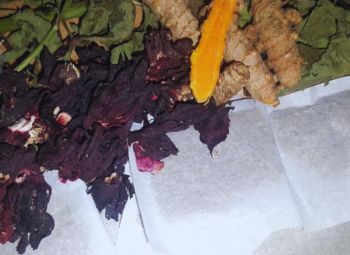
An experimental study design was used and the study was carried out in the food science laboratory of Catholic University of Cameroon, Bamenda. Roselle (Hibiscus Sabdaria), turmeric (Curcuma Longa) and cinnamon (Cinnamomum) were processed to powder form to form. They were combined to create the following formulations: Sample A = 100% Cinnamon Powder, Sample B = 70% Cinnamon, 20% Roselle, 10% Turmeric, Sample C = 50% Cinnamon, 40% Roselle, 10% Turmeric, Sample D= 40% Cinnamon, 50% Roselle, 10% Turmeric, Sample E = 20% Cinnamon, 70% Roselle, 10% Turmeric. Qualitative and quantitative phytochemical analysis, nutritional analysis and microbial analysis were conducted on all formulations. Sensory evaluation of the tea formulations was carried out using a 9-point hedonic scale. Data were analyzed using ANOVA in SPPS version 15. A value of <0.05 was regarded as statistically significant.
Results
There were significant differences for their physical, nutritional, phytochemical and sensory properties. There was no significant difference (p>0.05) in microbial load. Moisture content ranged from 10.1 to 11.4%, ash content 1.62 to 2.10 g/100g, fiber content 0.79 to 1.17g/100g, and vitamin C content 8.8 to 17.6 mg/100g. The phytochemicals: alkaloid, flavonoids and saponin ranged respectively from 2.67 to 6.11 mg/100g, 5.86 to 7.93 mg/100g, and 0.53 to 1.85 mg/100g. The bacteria count ranged from 2 to 11 CFU/mL. All the herbal tea samples were accepted by the sensory panellist for appearance, aroma, taste, texture and general acceptability.
Downloads
Published
Issue
Section
License
Authors retain all copyrights. In making a submission to World Nutrition, they are certifying that all material is theirs except quotations, as indicated, and that they have obtained permission for any photos, tables, or graphics taken from other publications or websites.