A Decadal transition in food labelling compliance with the Food Safety and Standards Authority of India regulations and the nutritional composition of processed packaged foods: Implications for public health
DOI:
https://doi.org/10.26596/wn.2025163120-131Keywords:
food labelling, nutrients of concern, FSSAI, processed packaged foods, ultra-processed foods, government regulation, food reformulationAbstract
Background
India is at the epicenter of the non-communicable disease epidemic, partly fuelled by the rising sales of highly processed packaged foods. In response, the FSSAI has implemented more stringent labelling regulations to promote healthier food processing and empower consumers to make informed dietary choices.
Objective
To study the shifts in labelling compliance with FSSAI regulations and the nutritional composition of highly processed packaged foods in the years 2013 and 2024.
Methods
In 2013, a cross-sectional survey of processed packaged foods (N=1020) was conducted in supermarkets of Vadodara city to examine various components of food labelling (ingredients list, Nutrition Facts Panel (NFP), nutrition and health claims, warnings and declarations, and allergen information). After a decade, the same products (N=200) were re-examined in 2024 to understand the changes in labelling.
Results
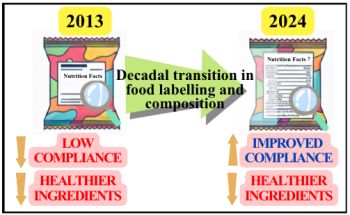
Over the decade, the following notable changes were observed in labelling: improved compliance in reporting of allergen information from 21% to 75% (p < 0.001) including the product claims, warnings, and declarations; an increase in the number of products reporting food additives; and significant improvement in the reporting of sodium and trans-fat on NFP (p < 0.001). The most unreported mandatory nutrient was “sugar” (2013) and “added sugar” (2024), with no significant changes observed in the reporting of energy, fat, sugar, and sodium content. Cocoa butter in chocolates has been partially replaced with hydrogenated vegetable oil, while palm oil has substituted other vegetable oils. These changes are primarily intended to reduce production costs but may compromise the product’s nutrient profile. Non-nutritive sweeteners have been partially substituted for sugar in beverages.
Conclusions
The current labels show improved compliance; however, this has not led to a significant shift toward healthier ingredients. Such a shift can be achieved only through mandatory reformulation policies.
Downloads
Published
Issue
Section
License
Authors retain all copyrights. In making a submission to World Nutrition, they are certifying that all material is theirs except quotations, as indicated, and that they have obtained permission for any photos, tables, or graphics taken from other publications or websites.